If you are interested in only one or two branches of this family tree, see Branches of the Family Tree in the sidebar on the right. Click on Thaden if you descend from Herman and Angelina Thaden. Click on Hahn if you descend from Sam and Hazel Hahn. Click on Romeo if you descend from Joe and Carmelina Romeo. Click on Bright if you descend from Fred and Nan Bright.
My children descend from a variety of cultures.
The BRIGHT family relocated from Pennsylvania to the booming riverfront town of Wyandotte, Kansas, shortly after the Civil War.
The MOORE family, of Scots-Irish descent, lived in the upcountry of South Carolina for a hundred years or more.
The THADEN family came from German immigrants and Tennessee Scots-Irish clans.
The NICHOLAS family originated in Tripoli and Beirut, Syria, and lived among a Syrian colony in Jacksonville, Florida.
The HAHN and LUTES families raced for land in the Oklahoma Land Run of 1893 and had been ever on the frontier prior to that time.
The ROMEO and MOTTA families immigrated to this country at the turn of the century from Sicily.
Sunday, January 6, 2019
What's In a Name?
Friday, January 26, 2018
See What Our Family Was Up to During
. . . the Mass Immigration through Ellis Island from Italy.
1890-1920
The Arrival of a Great Ocean Steam Ship at New York. Philadelphia: C. H. Graves, c1907. Library of Congress, Prints and Photographs Division[reproduction number LC-USZ62-89871].
Statue of Liberty, New York City. N.Y.C., c1898. Library of Congress, Prints and Photographs Division [reproduction number LC-USZ62-87198].
Ellis Island, c1913. Library of Congress, Prints and Photographs Division [reproduction number LC-USZ62-40101].
Tuesday, January 23, 2018
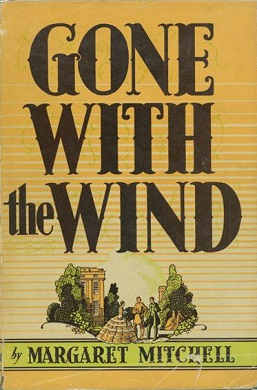
Gone With the Wind
Historical novels give valuable insight into the lives of people who lived in certain times. A good author puts a lot of research into the history of the places and events in which the characters are placed. Gone with the Wind by Margaret Mitchell is such a novel. Her thorough research provides lesson after lesson into the history of Reconstruction in Georgia--lessons that are not taught in public schools. Setting aside the loathsome characters of the hero and heroine, I recommend this book for anyone desiring a clearer picture of what really went on in the years during and after the War between the States.
Image from https://en.wikipedia.org/wiki/Gone_with_the_Wind_(novel).
See What Our Family Was Up to During
. . . The Reconstruction of the Southern States
1865-1920
Deckner, Garvin, Madden, Meigs, Moore, Nicholas, Pucket, Reagan, Rowland, Thaden
Image from https://www.theatlantic.com/photo/2012/02/the-civil-war-part-1-the-places/100241/.
See What Our Family Was Up to During
. . . La Miseria
1790-1910
Chité, Motta, Rapisarda, Romeo
See What Our Family Was Up to During
. . . the Early Days of the Mormon Church
Church, Lewis, Younger
See What Our Family Was Up to During
. . . America's Westward Expansion to Illinois
1763-1893
Day, Hudson, Rhoads, Van Meter, Watkins, Williams
This segment of the family history begins with Jacob and Alsey (Van Meter) Rhoads. Jacob, the son of a Revolutionary War soldier, originated in Pennsylvania. Alsey, possibly a nickname for Alcinda, came from Virginia and was of Dutch descent. The Rhoads and Van Meter families migrated, with Daniel Boone, to the area of Grayson and Hardin Counties, Kentucky. Here, Jacob and Alsey were married in 1785 and raised their family. One of their sons, Josiah, married Susannah Watkins, who was from Maryland. After Alsey died in 1828, most of the Rhoads family moved to Macoupin and Jersey Counties, Illinois.
In nearby Greene County, Illinois, David and Elizabeth (Williams) Hudson and their children had settled. One of David’s sons, Merritt, served in the Mexican War. He died in the Battle of Buena Vista in Mexico in 1847 leaving a young family. A nephew, David Hudson, went out west to California with the Forty-Niners in search of gold. After three years, he returned. David’s daughter, Martha, married Ira Day, a pioneer from Vermont. All of their children were born in Illinois.
Josiah Rhoads’ son, James, married Sarah Parker in Illinois and all of their children were born there. James’ son, Isaac, married Lydia Day, the daughter of Ira and Martha Day. All of their children were born in Illinois, one of whom was Lillie, who later settled in Oklahoma after her husband made the Great Land Run in 1893.
Image from https://nmwa.org/blog/2009/12/10/whats-going-on-in-this-picture/
See What Our Family Was Up to During
. . . America's Westward Expansion to Ohio
from Maryland and Virginia, 1803 - 1860
Hahn, Harless, Johnson, McNeely, Park, Tingley, Weisleder
Our direct ancestor, Adam Hahn, came to Columbiana County from Baltimore County in 1801, as soon as the land was opened up to settlement, and bought a section directly from the government; his brothers followed. Adam and his son, Andrew, set up a saw mill on Yellow Creek, and it was known as Hahn’s Mill for several years.
Adam and his brothers were quite prolific, and intermarried among the other pioneer families in the area. Andrew married in 1809 to Maria Magdalena Weisleder, later known as Mary. The Weisleders were former neighbors in Baltimore County. Weisleder translated means Whiteleather, and some descendants later became known by that name. Still attending German Lutheran and Reformed congregations, the new generation of parents continued naming their children with German-spelled names. A German-language family Bible was acquired sometime after 1819 by Andrew Hahn (born Andreas), and all family entries were written in German. It is likely these German American inhabitants of Columbiana County were still speaking German.
Mary’s father, Andreas Weisleder, was a native of the town of Stiege, now within the state of Sachsen-Anhalt, Germany. He was drafted into the army, and became one of the many thousands of Hessian soldiers sent to assist England in its war with the American Colonies. Finding himself a prisoner of war in Virginia, he determined none of his options were very good so he escaped and then deserted. Mingling in among the many sympathetic German settlers in the region, he made his way up to Manchester, Maryland, where he married Anna Maria Zentzin, of Swiss heritage. After having several children, they moved to Columbiana County in 1807 and purchased land from Adam Hahn.
When the War of 1812 broke out, a local militia was formed, and Andrew’s brothers, John and Adam, and a few of their cousins joined up. Andrew’s son, Samuel, a direct progenitor, moved on to Darke County, Ohio, on the western side of the state, in the late 1830s. Samuel’s cousin, also named Samuel Hahn, settled out there, as well. The Weisleders remained in Columbiana County and were very instrumental in its growth and progress. Our Samuel finding himself widowed with five children married Nancy Harless, herself a young widow, and from another prolific family, who had migrated over to Darke County from Virginia.
remained in the Darke County area, some moving just over the state line into Indiana.
Sunday, January 21, 2018
Grandfather's Flying Machine
"Old German Near Atlanta Is Builder of Machine
Has Made Short Flight
He Has Guarded the Machine Jealously and Has Been Working On It Ever Since the Wright Boys Flew Kites in Dayton.
Reported from Telegraph Bureau, Kimball House.
Atlanta, Oct. 25.
A made-in-Georgia airship, the darling of its inventor's heart and the fruit of ten years' hard work, is to be one of the most novel exhibits at the Great Southern Automobile show in Atlanta from November 8 to 15. It has made but a short flight so far, but its maker believes it will pass the clouds when a larger motor is put in.
H. Thaden, an aged German truck farmer, just outside of Atlanta, has been working on his airship since the days when the Wright boys were flying kites in the Dayton suburbs, and getting laughed at for their foolishness. But he did not follow the usual lines. His airship looks more like a boxcar than an aeroplane, its propellers fill both sides of the big structure, and the driver's seat throws the center of gravity so low Mr. Thaden is positive his craft can never turn over.
The old man has kept his queer ship hidden jealously for several years, but now that it is completed he is willing to show it to the public. He will be in personal charge of the exhibit and explain the workings of his ship to the interested visitors."
The article goes on to say John Philip Sousa's band and practically every automobile dealer in Georgia and the southern territory will at the auto show. They were proud to say they would have on display the first new models from all the factories several months in advance of the exhibits in New York and Chicago.--Macon [Georgia] Telegraph, 26 Oct 1913, p. 6.
Herman Thaden patented his airship in 1910. He was so very interested in aeronautics. He read the Aeronautics magazine and wrote a letter to the editor in 1911. As I read his letter, all his thoughts and concepts went right over my head. Such a technical letter. I marvel at his command of the English language. I admire him for his genius. I wish I had a photograph of his flying machine. There is supposed to be one in the Air and Space Museum at the Smithsonian. Perhaps one day I will find it.
Burial in Arlington National Cemetery
The funeral of Henry B. Thaden, long-time resident of the District, will be held from his home, 2317 M street at 10 o'clock tomorrow morning. The burial will be in Arlington cemetery. He was seventy-two years of age, and a veteran of the civil war. His widow, Mrs. Marie Thaden, survives him.--Evening Star [Washington, D.C.] 6 Jun 1910.
Singing in the Choir
This is a picture of Peck Memorial Presbyterian Chapel, the church to which Charles B. Thaden and his wife, Lydia, went each Sunday. They were married at this church in 1908.
"Last night at Peck Memorial Chapel Miss Lydia Dalton Hodgson, daughter of Mrs. John E. Hodgson, was married to Charles Thaden by the Rev. James M. Henry, pastor of the church. The bride entered with her brother, Mr. John W. Hodgson, who gave her in marriage. Her dainty dress was of soft white French lawn, trimmed in valenciennes lace. She carried a shower bouquet of bride roses and lilies of the valley, and her tulle veil was fastened with lilies of the valley. Mrs. Grace Schlosser, as matron of honor, wore white swiss and carried Golden Gate roses. The four brides maids wore dainty dresses of white organdie and carried bridesmaid roses. They were Miss Vannie Fauth, Miss Doris Denham and the Misses May and Irene Yost. The ushers were Mr. W. Shipley, Mr. Arthur Payne, Mr. W. Beckwith and Mr. William Cartwright. Lucien Thaden was best man for his brother. Mr. George H. Ward, organist of the church, rendered several selections and two wedding marches. The chapel was prettily decorated with palms and daisies by the members of the church. Mr. and Mrs. Thaden left soon afterward for Atlanta, Ga., where they will be the guests of Mr. and Mrs. H. Thaden, who are to give a reception in their honor next Thursday night."
Interestingly, the best man and and bridesmaid Doris Denham later became husband and wife. Mr. and Mrs. H. Thaden in Atlanta were Charles' uncle and aunt.
Lydia sang soprano in the small church choir. There were three other sopranos, two altos, two basses, and a tenor. They were accompanied by organ. One year they gave a special evening Christmas song service and sang "Sing, Oh Heavens," "Behold I Bring You Tidings," and "Holy Night."
The Peck Chapel was located at the intersection of Pennsylvania Avenue and M Street. It was founded in 1886 as a mission outreach church in Georgetown, which provided vocational education for minorities and disadvantaged youth. The church was sold to another organization in 1938 and was finally demolished in 1951. The above photo shows an image of the church photoshopped into a current image to show its location. https://georgetownmetropolitan.com/2015/12/09/now-and-a-long-time-ago-pennsylvania-and-m-st/.
The Depletion of Frank De Mayo's Wealth
Undated article, and no place: "Gnawed at Dice Riches"
Pay-off Fees and Lawyers Cut into De Mayo's Money.
The $230,000 Accumulated in 1917 Went to Varied "Takers," Ex-bootlegger Tells Bankruptcy Referee.
Frank De Mayo, the former "bootleg king," who used to boast that "everybody had a price," was on the grill today before the referee in bankruptcy, harking back to his prosperous bootlegging days to explain the fading of a dice fortune, estimated by him at $230,000 at one time.
De Mayo has been trying to explain to Henry A. Bundschu, referee, and the trustee of his estate, that he is broke; that his small fortune, which reached a peak in 1917 of a quarter million, is now gone.
Bundschu is trying to trace the disposition of De Mayo's estate and gather up any missing assets to satisfy his creditors. De Mayo filed a voluntary petition in bankruptcy July 12, stating he had only $1,000 left of his own to meet debts and judgments of more than $300,000.
The former booze runner, Bundschu learned today, would have most persons believe his fortune was spent in "fixing" public officials, paying off fines and compensating lawyers for getting him out of trouble in the prohibition era.
Testimony by De Mayo before Bundschu discloses he had $250,000 in 1917 when he was 27 years old, realized by dice games and other gambling in pool halls he operated between 1907 and 1917.
In 1928, when he became involved with federal authorities over his illicit booze traffic, his fortune began to dwindle, he told Bundschu. He testified he paid the late Frank Walsh and other lawyers a $50,000 retainer fee for an unsuccessful effort to "wiggle" him out of the clutches of Uncle Sam.
During the Prohibition era, De Mayo told Bundsch, he spent much money in "fixing" public officials, and used his last $100,000 in "trying to keep out of jail." He finally received a federal penitentiary sentence and served it.
De Mayo has told the federal bankruptcy court he gave Mrs. Bessie De Mayo, his wife, large amounts on many occasions when he "was in the money."
In 1931, after his release from prison, he went in the oil business, forming the De Mayo Oil company, and bought up leases on 3,400 acres of oil land in Eastern Texas with his wife's money, he has stated. He paid $85,000 for the lease options out of one-third of the oil profits in eight years, according to his statements to Bundschu.
Mrs. De Mayo owns the oil company, which, he says, he manages for her. The late Casimir J. Welch, East Fifteenth street Democratic leader, was a partner for a time in the De Mayo Oil company, according to De Mayo. Records show Mrs. De Mayo in 1931 invested $56,000 in the Muskogee Natural Gas company and later sold her interests for $70,000.
De Mayo even capitalized on liquor investments after repeal of the eighteenth amendment, he says. In 1933, he sold warehouse receipts he had obtained on legal whisky at a profit of $5,000, which now, he told his interrogator, is gone. He also said he made a profit on $5,000 on Dominion of Canada bonds in 1933, and in 1934 he lost $40,000 in an Edgerton, Mo., distillery failure.
Then, in 1933 and 1935, he invested some of his wife's earnings in two cabinet manufacturing concerns, realizing a profit for her, he related, of about $22,000. He stated his wife's present income is $25,000 a year from the Texas oil leases.
[$230,000 in 1935 is equivalent to $4,000,000 in 2016. $25,000 in 1935 is equivalent to $438,000. The image of Frank De Mayo comes from nationalcrimesyndicate.com.]
Halloween 1906
I came across an article about Lucien Hayo Thaden and a Halloween party he attended in 1906. When reading this article, I was struck by how Halloween parties have come through a vast evolution. Here is the article:
Henry Thaden Class of 1909
Henry Bernard Thaden graduated from the Linthicum Institute housed in this building in 1909. I located a newspaper article reporting on the commencement exercises in the Washington Post dated 27 May 1909. Henry was 16 years old.
"Boy Students Give Plays.
Commencement Feature at Linthicum Institute.
Medals and Cash in Gold Awarded Winners of Prizes for Highest Standing in Studies.
Commencement exercises marking the close of the thirty-fourth school year of the Linthicum Institute in Georgetown were held at the school on O street before a large audience of relatives and friends of the hundred or more students of the institution. High honor was paid to the name of Edward Magruder Linthicum, formerly a prominent business man of Washington, who in his will left $75,000 for the erection of the school where poor boys might obtain a free education after working hours.
Boys of all ages who are on the rolls took part in the interesting program last evening, of which the principal numbers were three one-act plays. . . . The sketches were done well by the boys, and kept the audience in laughter for more than an hour and a half. [There were several piano numbers by an alumna.] Rev. J. T. Marshall, pastor of the West Presbyterian Church, offered prayer.
At the close of the program prizes for work during the year were presented by . . . a member of the board of trustees. He complimented the students on what they had accomplished in the year, and told of the close contest for the various medals. [H. B. Thaden was not among the prize winners, but he was listed with others receiving 'special mention.']
After the exercises had been concluded the visitors were taken through the school building and shown the clever work of the students in the several classrooms. . . ."
Henry's parents and three older brothers were likely in attendance at this graduation program. They were probably quite interested in looking at Henry's classroom and desk where he sat with his school work. The school was located about 15 blocks northwest of their home at 2317 M Street NW. It appears there was probably a street car line going right down O Street in front of the school.
From The Chronicles of Georgetown, D.C., from 1751-1878 by Richard Plummer Jackson, published in Washington, D.C. by R. O. Polkinhorn in 1878 on pages 238-244.:
Edward Magruder Linthicum grew up poor, but through hard work, he attained success and retired in comfort. An extract of his will reveals that he believed ". . . knowledge and piety constitute the only assurance of happiness and healthful progress to the human race. . ." He gave $50,000 [not $75,000 as the 1909 article stated] to his friends to become his trustees and establish and maintain "a free school for the education and instruction of indigent white boys and youths of Georgetown in useful learning, and in the spirit and practice of Christian virtue . . ." The trustees worked with the Georgetown city school system in building a large school house opposite St. John's Church between High and Market Streets. It was agreed "to set apart, free from rent, a room on the ground floor of the main front" of the building for the Linthicum Institute. The school was opened 1 Oct 1875 in the Curtis School Building. Night school classes were held for working boys from 7:00 to 9:00 every evening, except Saturday and Sunday, in penmanship, bookkeeping, drawing, arithmetic, geometry, chemistry, and physics. Two other schools operated separately in this same building.
The building no longer exists, but it was located across O Street from St. John's Episcopal Church, and next to the Hyde School; both of these buildings are still standing. According to a 1890 map of Georgetown, Potomac Street lay between Market and High Streets, which were mentioned in the above article. A close comparison of this map and a current map shows that High Street is now Wisconsin Avenue NW; Market Street is now 33rd Street NW; and today's O Street NW was once called First Street. The Curtis School Building more accurately sat at the northeast corner of Potomac and O Streets. The Hyde School playground now occupies the spot.
Image of Curtis School Building from The Georgetown Metropolitan, "Survey of Historic School Buildings in Georgetown, 9 Nov 2009, accessed 21 Nov 2018,
https://georgetownmetropolitan.com/2009/11/09/survey-of-historic-school-buildings-in-georgetown-hyde-school/.
Friday, September 8, 2017
Managing the North Sea
Tuesday, May 9, 2017
Adolphus and Lucretia
Adolphus Lutz was born in North Carolina and was the grandson of John and Sallie Frye Lutz. By the time Dolph was of marrying age, the Lutz family lived in Missouri. There he married Missouri-born Lucretia Boydston. I am curious about their given names.
According to Behind the Name, Adolphus is the Latinized form of the Germanic Adolf. Dolph's ancestry was indeed German, but why did his parents use the Latin version? It was most popular in 1893 when it ranked 330 in popularity. Dolph was 40 years old at this time.
Likewise, the name Lucretia is ancient Roman in origin. It was most popular in America in 1882 when it ranked at 205; Lucretia was 19 years old.
So both of these individuals were born before their names were trendy. Perhaps their parents helped to set the trend. Research has found that during the time these two were born, Americans were fascinated by ancient Rome. Classical style and philosophy seeped into their culture, and therefore their naming traditions.
Historically, Lucretia was a legendary ancient Roman woman whose tragic fate set in motion a revolution that removed the Roman monarchy sometime in the 500s BC and replaced it with a republic. Lucretia was ever after honored for her sacrifice.
As for Dolph, perhaps his parents wished to bestow a name reminiscent of his German culture. Adolf means noble wolf and was borne by several Swedish kings. Latinizing the name brought it to current cultural standards.
It will be interesting to notice how many other names in the family history were influenced by Roman Classical interest.
John and Sallie Frye Lutz, mentioned at the top of this post, are my husband's 3rd great grandparents.
Tuesday, January 26, 2016
Learning More from the OSBs
The OSB took me only so far back in time, to the 1600s. I suppose this must be about the time when the Lutheran church there in Dornum was organized. So I suspect that Thade was the name of an ancestral father of Jacob Ulfers. Perhaps Ulfer's name was Ulfer Thaden. Then his father's first name would be Thade. But at this point, we are getting back to people who probably didn't even keep records.
All of this sparks my curiosity in the history and culture of Ostriesland. Where did these people come from, and how did they live? What kinds of things did they eat and how was it prepared? What natural resources did they use for their survival? How did the ocean influence their lives?
Time to study now.
Tuesday, January 12, 2016
The Cornicello
Picture from http://www.consiglioskitchenware.com/cornicello-italian-horn-charm-keychain-medium
Passport Application of Joe Romeo
This is the passport application of Joe Romeo. After he served in the World War, he planned a trip to visit his parents in Belpasso. He came back to America with a bride!
Saturday, January 9, 2016
The Ortssippenbuch of Dornum
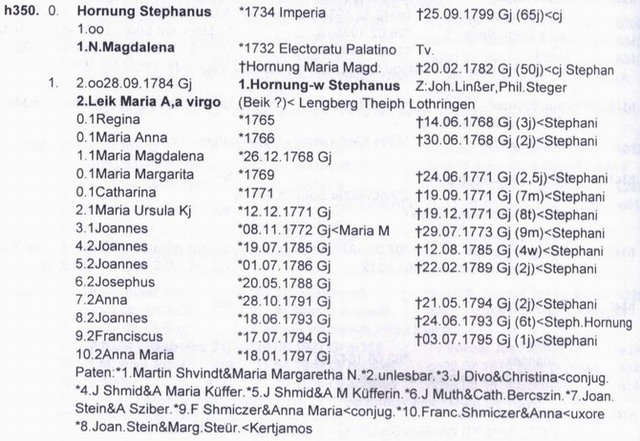
"The Ortssippenbuch (OSB) is a book of the compiled records from a parish and sometimes from other local sources that organize people and their events into family groups. Each family group is usually assigned a number within this book and that family number leads to other family numbers so that you can connect numerous family generations together. Dates are given for births/baptisms, marriages and deaths and burials. It lists all the children that are born in this village and also if parents have come from elsewhere as well as other useful information. You might even find a reference if your ancestor immigrated to another country."--https://familysearch.org/blog/en/ortssippenbuch-shortcut-german-family-history-research/.
Not every region in Germany has them. Many of the towns in the region of Ostfriesland have OSBs, local kinship books, and more are being added all the time. We are very fortunate that the OSB for Dornum was published in 2012. This two-volume set cost me a pretty penny, but it has been worth it.
Brothers Herman and Bernard Thaden emigrated from Dornum to the US in the 1860s. In the OSB, I have found them listed with their siblings and parents. This OSB lists quite a few Thaden families going back several generations. It is a goldmine of information. Above is a picture of a typical page within an OSB.
Of course it is written in German, and I have to have the Google translator open while reading the entries. The symbols are intriguing. An asterisk (*) appears before a birth date like it's the day the child burst forth into the world. A tilda (~) appears before a christening date. It looks like baptismal water. An infinity symbol (∞) appears before a marriage date. That's kinda cool since some people belive in eternal marriage. The Christian cross (†) appears before a death date. That's logical. And an open box symbol appears before a burial date. It looks like a coffin.
I have learned that most christenings took place in the family residence with three or four witnesses. Emergency christenings took place when a baby had but little time to live. And the infant mortality rate was really high.
I really love the OSBs. They are a valuable genalogical tool.